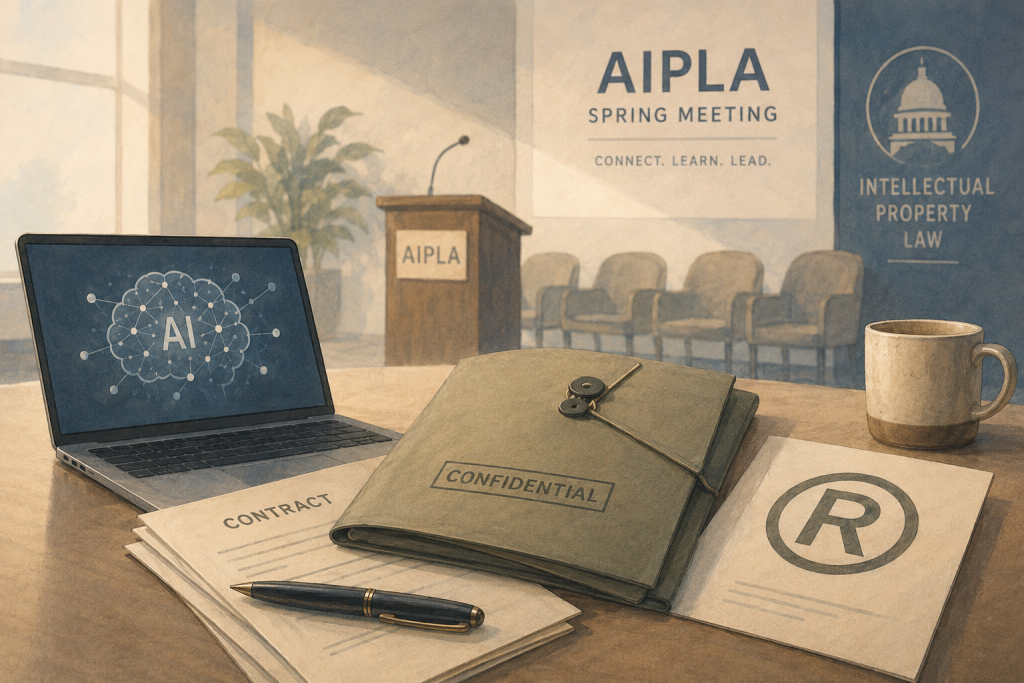
The American Intellectual Property Law Association’s Spring Meeting kicks off this week, and three sessions on the agenda highlight issues that should be on every software company’s radar. Each is a place where the traditional IP playbook is starting to crack under the weight of AI and evolving market behavior.
Here’s what to keep an eye on:
- AI-DRIVEN DEALS: When a transaction involves training data, a machine-learning model, and the outputs that come from it, each of those is its own asset. This means each has its own ownership, confidentiality, and indemnification questions. Cross-border data transfers and emerging AI regulation in the U.S., EU, and Asia complicate things further. If your company is buying, selling, licensing, or jointly developing anything AI-related, the contract structures that worked five years ago are no longer enough. Audit clauses, output attribution, and trade-secret carve-outs all need fresh attention.
- AI AND TRADE SECRETS: The harder question on the horizon is whether a competitor can reverse-engineer your trade secret by feeding public-facing pieces of your product into an AI tool. Courts are just beginning to grapple with what this means for the “reasonable measures” standard under the Defend Trade Secrets Act and its state-law analogues. The practical takeaway: if your trade-secret program was last updated before generative AI was widely available, it’s worth a fresh look. This particularly true related to your access controls, contracts with third parties, and what gets exposed in customer-facing interfaces.
- TRADEMARK FAILURE-TO-FUNCTION: The Federal Circuit’s 2025 decision in In re Brunetti and recent district court rulings (including Penn State v. Vintage Brand and Top Brand v. Cozy Comfort) are reshaping what can and cannot serve as a trademark. Examining attorneys are increasingly using marketplace evidence to refuse registration of slogans, social messages, and commonplace phrases . Relatedly, defendants in infringement cases are asserting failure-to-function as a defense. If your brand strategy relies on slogans, hashtags, or meme-adjacent phrasing, the post-Brunetti landscape changes how you should approach clearance, prosecution, and enforcement.
How courts and the USPTO handle these three areas over the next year will shape the IP landscape for software companies in real, practical ways. If any of them touch your business, this is a good time to take stock. It is better to understand these issue now and before the next deal, the next demand letter, or the next refusal lands on your desk.