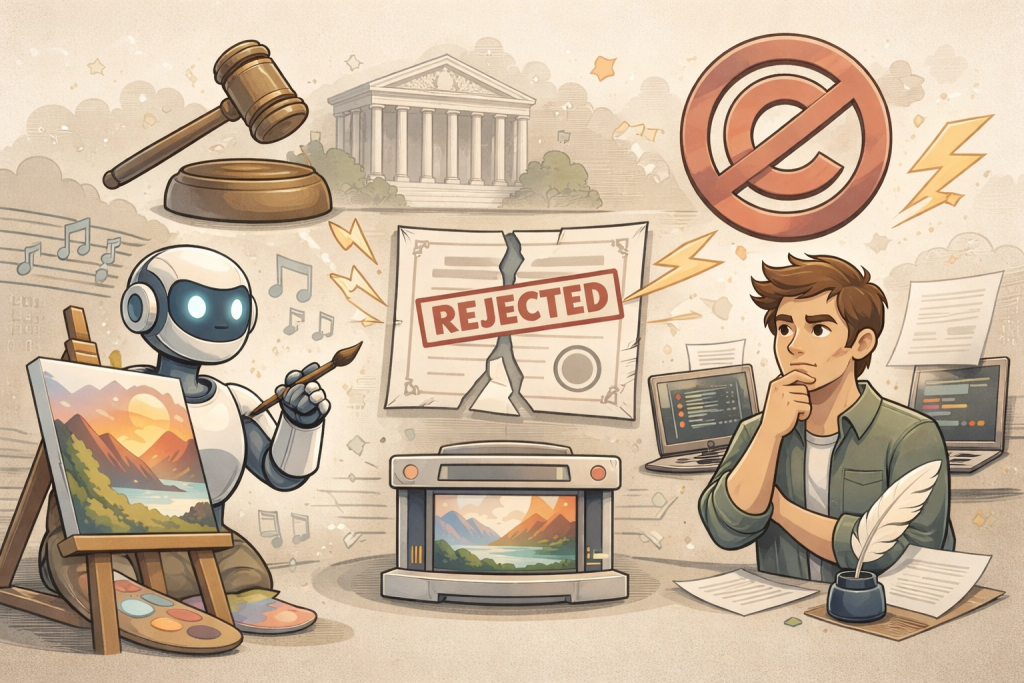
On March 2, 2026, the U.S. Supreme Court turned away a petition asking it to decide whether artwork produced entirely by artificial intelligence qualifies for copyright registration. By refusing to take up the case, the Court left undisturbed a ruling from the D.C. Circuit that backed the Copyright Office’s longstanding view: only humans can be recognized as authors under federal law. If your software company builds products that generate creative output, this is a significant development to understand.
The dispute centered on Stephen Thaler, a computer scientist who designed an AI system and then sought to register a visual artwork the system produced on its own. Rather than listing himself as author, Thaler named the AI and argued that ownership should flow to him through either a work for hire theory or through the property law principle that the owner of a machine also owns what it creates. The Copyright Office refused the application. A federal trial court agreed, and the D.C. Circuit upheld that result, pointing to multiple provisions in the Copyright Act that assume authors are living people, including sections addressing inheritance, spousal transfers, and the capacity to sign agreements.
The practical weight of this ruling is real, but so are its boundaries. Everything turns on the phrase “entirely by AI.” The appeals court itself observed that Thaler could have put his own name on the application rather than crediting the machine, which suggests that works involving genuine human creative judgment may still find protection. The Copyright Office has echoed that distinction in recent guidance, reviewing applications involving AI tools individually and requiring disclosure of which portions were machine generated. The parts shaped by human creativity may be registrable. The parts that are purely algorithmic output will not be.
Whether this framework survives the next few years is an open question. Thaler’s attorney noted that a separate challenge in Colorado could produce a split among the federal appellate courts, which is often what it takes to bring the Supreme Court back into a legal debate. Meanwhile, other countries are charting their own paths. The United Kingdom extends protection to whoever arranges for a computer generated work to be made, and courts in China have recognized copyright in certain AI produced images. For software businesses operating across borders, that divergence adds a layer of real complexity to IP strategy.
The bottom line for your company is this: if AI tools play a role in producing content, code, or creative assets, make sure identifiable human decision making is baked into the workflow. Document the choices your team makes at every stage, from selecting inputs to curating and editing outputs. That human layer is what separates protectable work from material that anyone can freely reproduce. If AI generated content is a meaningful part of your product or your IP portfolio, the time to think about your authorship strategy is now, not after someone copies your work and tells you there is nothing you can do about it.